Showing posts with label china. Show all posts

Sunday, November 10, 2013

Virtual Tour of Earth's Evolution

The Story of Earth: The First 4.5 Billion Years, From Stardust to Living Planet; by Robert Hazen. 2012. Viking Books. $28.

The first post/book review I failed to provide any maps. And, there are lots of maps I could have posted. Many places around on our planet illustrate the changes our planet has undergone in the brief 4.5 billion years our planet has been in existence.

With this post, I'm going to provide a few maps which will help us see the geographic distribution and variety of sampling locations on our planet which showcase the information we have access to.

The United States

I'm going to begin our journey where the author began his journey of study of the Earth's geology. Our first stop is Cleveland, Ohio. The author's boyhood home is near Cleveland. Within the environs of Ohio's 2nd largest city, many sites contain Devonian age (420-360 MYA) aquatic fossils.


View Larger Map

One can visit places in Montana where the rock layer sequences are physically accessible. A visitor could literally lay their hands on rocks half-a-billion years old.


View Larger Map

Later in our author's academic life, Dr. Hazen would take a field trip to the community of Nahant, Massachusetts. Rare shell-building fauna are exposed in Cambrian age layers (540-500 MYA) on this tiny spit of land hanging off the coast of Massachusetts.

I don't want to limit our experience to the United States, though. Yes, the U.S. does have an amazing abundance of fossil of all types, representing over 500 million years of life on Planet Earth. However, the U.S. is not alone in its abundance of fossil-bearing rocks.

China

In the southern province of Guizhou, China, we can travel back to the end of the Endiacaran Period, 580 MYA, and examine sponges with hardened spines. Creatures were beginning to utilize minerals in solution for building themselves little protective shells.


View Larger Map

Morocco
In the Anti-Atlas mountains of western Morocco we can find more evidence of Ediacaran Period sediments. Near the settlement of Anoun'Tout, Morocco, and near the Souss River, fossil-bearing rock strata provide millions of years of carbonate evidence.


View Larger Map

But, at 500 MYA, we have only scratched the surface of Earth's lifespan. Can we go farther back than 500 MYA? Are there places we can visit which can yield more clues to the geologic and perhaps biologic history of the Earth? After all, 500 MYA is only about 1/9th, 11%, of the Earth's 4.5 billion year lifespan.

Canada

As it turns out, yes. And, as it turns out for Canadians and U.S. citizens, we don't have to leave North America to find our evidence.


View Larger Map

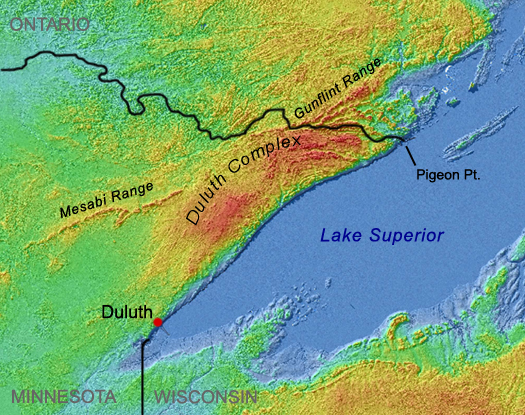
In the Gunflint Range, a thin offshoot of the Duluth Complex, located on the western shore of Lake Superior, we can find what paleontologists say are cherts which hold the oldest "absolutely unambiguous fossils of photosynthetic cells on Earth." (173) Ancient microbial fossils have been dated back 1.9 billion years.

Duluth Complex

However, if we really want to go as far back in time as possible, to locate the oldest known evidence of ancient microbes, of photosynthetic microbes, and essentially life, we could visit Shark Bay, Australia. I know what you are thinking: Australia gets all the cool stuff.

Shark Bay, Australia, is home to stromatolites. The living stromatolites of Shark Bay are so unique and peculiar this place is has been recognized as a World Heritage Site. These stromatolites tipped-off paleontologists that other structures found around the world were the result of microbes building reef systems. Analysis of these reef systems have provided dates going back as far as 3.5 billions years.


View Larger Map

Finally, to wrap up our small journey here I mention the Deep Carbon Observatory. Unlike a stellar observatory, or a space-based observation platform, the Deep Carbon Observatory (DCO) represents an international coalition of organizations and scientists pooling research interests to better understand the role of Carbon on a planetary scale. We can visit their web site, but their physical aspect is distributed among the Univesity of Rhode Island, Rensselaer Polytechnic Institute, and the Carnegie Institution of Washington. The DCO also enjoys global support from a network of partners (map) and community member who contribute towards research goals.

Wednesday, November 7, 2012

How Memes Explain GOP Dysfunction

I'm amending my post based on results from the 2012 Presidential Election. Comments by GOP pundits speak directly to my comments below. Both Karl Rove and Charles Krauthammer exemplify the anti-rational memes I identify and discuss below. Krauthammer, in fact, argues the GOP platform needs no changes; the GOP simply couldn't motivate the proper personalities to communicate the Republican message. If the message is so complicated 9 candidates cannot communicate the "message," the problem might be the message.
My previous post, a book review of D. Deutsch's The Beginning of Infinity, left a cliffhanger, of sort. D. Deutsch spoke of static versus dynamic societies, specifically, static societies fail; dynamic societies endure, unless compromised or infected with non-rational memes. Then, demise of a society is a guaranteed surety. I dropped a parenthetical comment within my review indicating I would speak more on this topic later. This is later.
David Deutsch introduces a stunning array of ideas in a few short pages. He essentially breaks down culture and the transmission of cultural ideas and describes the bifurcation of a society’s choices into two paths. One path takes society down a static path, and essentially the end of that society. The other path takes society down a dynamic path, and persistence. Sounds a lot like Robert Frost, “the path not taken.”
My chosen theme for my writing is geography, the entire milieu of geography. When a quantum physicist wanders into the realm of culture and nation-building, my “geography-sense” begins to tingle. I have nigh-incomplete knowledge of quantum physics but I have a lesser amount of incomplete knowledge about geography. However, tying a few ideas from The Beginning of Infinity (TBOI) to geography should not be too difficult. What comes thereafter, might be.
The notion static societies and dynamic societies are part of the milieu of geography should not be too indulgent; this notion should be self-evident, actually. TBOI introduces a term which is not generally used in geography. The term is expressed more in sociology, or psychology, perhaps. However, TBOI introduces the term as a fundamental components of culture. The analysis of the term is used to examine the general success or failure of societies within a historical context. For instance, the failure of the Roman Empire, the failure of Nazism, the failure of the Soviet Union are all potentially explained by the function of a single term, and the terms components.

What is a meme?

Richard Dawkins, in his book The Selfish Gene (1976), posited the idea of a “meme.” A meme is a self-replicating idea (369). But not this simple, as a meme is a self-replicating idea within a culture much like a gene is a self-replicating set of biological instructions which communicates to cell how to develop. Memes carry cultural instructions which communicate and define individual’s behavior within a culture.

A meme is a self-replicating idea which carries the cultural instructions which communicate and define an individual’s behavior within a culture. Memes can mutate due to societal pressures, therefore memes evolve over time.

Thousands of memes can exist. Memes can arise and disappear within a person’s lifetime, or they can persist over generations. Memes can self-replicate with varying degrees of success. Some memes persist over time with considerable fidelity; they do not lose their message. Some memes adapt over time and evolve. The information content will change; did a new meme arise and replace the old meme? Or, is the meme simply a mutation?
Memes can be categorized as one of two types. “Rational” memes are based upon rational and critical thought (388). Being based upon rational and critical thought, rational memes are able to be accurately replicated. Rational memes evolve in the direction of real understanding and knowledge (389).
Anti-rational” memes are founded upon non-rational thought or non-critical thought (388). Non-rational thought or non-critical thought is a means of saying the idea is not likely to be replicated with any degree of accuracy. An example of non-critical thought is the response to a question, “because I said so.” Another example includes memes which are based on religious ideologies, faith-based ideologies, or political-based ideologies. An example of such anti-rational memes would include the belief women are inferior or too delicate to vote or to become involved in politics, or the notion Blacks or people of color are inferior, or the notion the only true faith is Judaism. Anti-rational memes mutate away from developing better understanding and increased knowledge, and in doing so hinder or eliminate adaptations which encourage greater critical thinking.
Rational memes arise from critical thinking and encourage greater understanding through promoting more rational thought.
Anti-rational memes arise to hinder or prevent critical thinking and impair understanding and restrain knowledge.
Rational memes persist and are enjoyed throughout society and across time. Rational memes succeed in spite of debates and criticism because the memes themselves inspire debate and criticism, becoming better and accepted throughout society. The example set forth in TBOI are the Laws of Motion described by Isaac Newton. Newtonian physics not only is useful for construction, such as cathedrals and bridges, and useful for artillery (388). In other words, rational memes are useful across a broad spectrum of people and disciplines, are well-suited for being re-purposed, and foster more criticism and debate.

Anti-rational memes can persist and spread among people in the very same as rational memes. However, their effect is different. Anti-rational memes harm society (378). Anti-rational memes discourage criticism, debate, the pursuit of knowledge and deeper meaning. These effects may see mundane, yet the effects of those effects tend not to be mundane. Discouraging criticism and debate leads to the rise of police states, censorship of the media, detainment, loss of freedoms, imprisonment, or death. Russia has created a set of Internet censorship laws which greatly restricts access to the media, makes libel a criminal offense, and forces foreign news reporters to register as foreign agents (Atlantic, 3 Nov 2012). Fascism is another example of an anti-rational meme. Fascism is the unquestioning devotion to an ideology, typically a political ideology. Fascism is not limited to politics; the adherence to religious indoctrination in the face of contrary evidence is also a form of fascism. The United States is not immune to anti-rational memes. The Salem Witch trials springs to mind, the Red Scare & McCarthyism of the 1950s, and the "You Are Either With Us Or Against Us" domestic and foreign policy during the 2001-2008 Bush Administration are all forms of fascism, and anti-rational memes. The persecution of Julian Assange and WikiLeaks is an interesting circumstance. Yet, despite the controversy, I would argue this persecution is also an anti-rational meme because deeper truths are being hidden or concealed. This is precisely the nature of anti-rational memes.
The precise nature of anti-rational memes is to work against the revelation of knowledge, to blur or conceal the truth.
At this point I'm departing from my synopsis of memes, and discuss of rational and anti-rational memes. Rational memes are consistent with dynamic societies. Dynamic societies are not immune to the dangers of anti-rational memes. Within dynamic societies, both types of memes exist and are both exposed to the same sets of criticism. Anti-rational memes do not stand up to criticism, however, falter, fade away, and are replaced by rational memes. Even rational memes are under constant scrutiny and may be replaced by new memes or evolve into a new meme. Because of the continual improvement of rational memes in dynamic societies, the memes themselves become increasingly easier to replicate without loss of fidelity (388).
All meme forms and variants can exist within a dynamic society. Dynamic societies allow scrutiny and criticism of memes. Anti-rational memes will be identified as false, shallow, or useless. Rational memes will persist under critical observation and will be replicated accurately.
Static societies may have rational memes. However, due to the persistence of anti-rational memes, rational memes are disposed. Anti-rational memes can be as faithfully replicated as rational memes. For example, slavery in the United States was a persistent anti-rational meme based on several specious arguments. Generation after generation of people in the U.S. South were indoctrinated into the Slavery System. Most any attempt to argue against slavery, i.e. to criticize the meme, was immediately squelched. Static societies encourage the Status Quo, suppress criticism, and enforce invariant compliance of anti-rational memes (381). Laws are passed which encode the meme into the social fabric, such as the "Sundown Laws" which persisted in the United States well after Black Emancipation. Society may even foster and encourage the use of taboos to control behavior. Even within the allegedly "free and open" United States, some mixed race couples continue to find bias and discrimination.

Static societies are doomed to fail. Static societies impose rules, regulations, and restrictions which have the effect of ultimately shutting down human creativity. Human creativity is essential for meme evolution and transmission
.

The society of the United States is generally associated with being a "dynamic" society. Many societies today are dynamic societies. All of Europe, India, the United States, Chile, Argentina, Canada, are all examples of "dynamic" societies. If you don't see your country mentioned, its probably still dynamic, I merely did not want to develop a comprehensive list. As long as a society is able to evolve to more rational ideas, i.e. rational memes, the society has a good chance of being a "dynamic" society.

Some societies I tend to think of as being dangerously close to becoming static societies. Russia comes to mind. The more restrictive the government becomes, the more speech and political expression is curtailed, the more likely Russia will become static. China falls into the same category for essentially the same reason. North Korea is a static society. Venezuela under the rule of Hugo Chavez, becomes more of a static society under his strict leadership. Any of the Middle Eastern countries, Iran, Iraq, Saudi Arabia, Egypt, the Maghreb countries, and many countries of sub-Saharan Africa have the potential of becoming static societies. Rules, laws, or taboos which restrictive the free movement of ideas, or limit certain populations are anti-rational memes. Limiting the role of women in business, industry, sports, or government are anti-rational memes. Discriminating against a population based on skin color or other physical traits is an anti-rational meme. The killing of albinos in Tanzania because they are seen as "ghost" people is an anti-rational meme. The notion in Malawi of having sex with a virgin girl as a cure for AIDS/HIV is an anti-rational meme.
In the United States, our political parties are susceptible to becoming victimized by the spread of anti-rational memes. The Democratic Party support of unions is an anti-rational meme which hinders business, disallows the movement of ineffective workers and their inherent inefficiencies, and prevents the replacement of outmoded business models with modern adaptations.
The Tea Party movement itself is based almost exclusively on a host of anti-rational memes, racism, Creationism, pro-Christian, pro-faith, and a return to the Gold Standard are simply a few anti-rational memes prevalent among the Tea Party.

Republicans, especially Conservative Republicans, have become significantly enamored by anti-rational memes. The "Patriot Act" provided unparalleled access to law enforcement for domestic surveillance. During the Bush Administration, citizens throughout the country found their "patriotism" challenged by simply criticizing White House policies. Members of the Senate Science and Technology Committee side with Creationists and other anti-science advocates against current research extending from the study of Cosmology, evolution, stem cell research, to climate change. Conservative Republicans, such as Donald Trump persist in perpetuating the Birther meme concerning President Obama's place of birth and his academic record. Other Conservative Republicans persist in associating environmental catastrophes like Hurricane Katrina and Hurricane Sally with God's wrath against the moral turpitude of homosexuality and abortion. The current political clarion among Republicans, "Take Back America" exemplifies yet another anti-rational meme. The United States has not been lost, has not been over-run or taken over. The government is not besieged. A coup d'etat has not supplanted any of our three government divisions.
Dynamic societies succeed by critical investigation of memes, by moot, and by using human creativity to expose, evaluate, and adapt memes. As memes are replicated, and evolve, individual memes may become static (383). Static memes are not necessarily bad. The idea of one-person, one-vote is a static meme which is important for governance which cannot really get more any more simple. Remember, the previous memes prevented women from voting, black males could cast a vote which counted as 1/2 the vote of a white male, and only white landowners could vote. Individual memes may become static. Danger arises when static memes become encoded with the law, or imposed by taboo, and society in its entirety is restricted from exercising creativity in advancing knowledge and gaining deeper understanding.

The two major parties, the Democrats and the Republicans, are catalysts for memes. Democrats, often referred to as "Liberals," are criticized for simply being that, liberal. Liberal carries many connotation; open, explorative, educated, flexible, wavering, and progressive are a few terms which come to mind. Republicans are often characterized as "Conservative," meaning resistant to change, parochial, narrow-minded, and traditional are a few terms which come to mind.

Both political parties are far from perfect. However, Republicans are dangerously close to becoming the bastion of anti-rational memes. Advocating increased levels of religious expression in schools disaffect members of a society which purports to be accepting is an anti-rational meme. Anti-science faith-based messages which articulate evolution and cosmological sciences as being straight from Hell is an anti-rational meme. Deprecating education at levels beyond high school is an anti-rational meme. Denouncing climate and atmospheric sciences is an anti-rational meme. Advocating the status quo upon reliance on fossil fuels and against alternative energies is an anti-rational meme. Denouncing the rights of gay and lesbian citizens based on religious intolerance is an anti-rational meme. Stripping rights away from individuals to exercise control over her own reproductive rights in an anti-rational meme. Restricting the use of embryonic stem cells on religious grounds is an anti-rational meme.

For Democracy to succeed, at least two parties of equal rational and critical thinking acumen are necessary. My criticism of the Republican party is levied mostly to vent frustration over the entire political process. In reading TBOI, particularly the portion regarding memes and culture, I was struck by the relevance of Deutsch's comments and their applicability to current societal and governmental concerns. Much of the vitriol of our current political climate arises from anti-rational memes, examples of which I have already mentioned. These anti-rational memes are associated with members of one political party, are encoded within that party's platform, in fact. That the GOP cannot mount a substantive and unified front to the Democrat Party can be tied directly to the anti-rational memes harbored by many Republicans. To provide a better leadership at local, state, and national level, GOP leaders need to scrutinized their platform, their ideals, eliminate those notions which are parochial, limiting, predicated on ignorance and non-critical thinking, and purge their party of members who support anti-rational, non-critical memes. Otherwise, the Republicans are dooming themselves to irrelevance, being diluted by more non-critical thinkers, and radicalists, eventually being replaced by a number of factions.

Source: Deutsch, David; The Beginning of Infinity; Penguin; 2011.


Monday, June 4, 2012

Book Review: False Economy

False Economy, by Alan Beattie. Published by Penguin and Riverhead Books. Copyright 2009. Paperback. $16.

My interest in economics certainly cannot be traced to my college experience with Micro- or Macroeconomics. Both classes were taught be the same gentleman, Mr. Johnson. Mr. Johnson tended to be tardy and always arrived with a ceramic coffee cup of the vintage found in cafeterias. The class had to be somewhat forgiving of Mr. Johnson.

Mr. Johnson was old. He was so old I had no trouble imagining him following Adam Smith around the English countryside taking copious notes. I'm pretty sure he pre-dated the invention of the Supple-Demand curve; hell, he probably pre-dated supply and demand.

My only memories of those classes were of Mr. Johnson, all nine decades of him, standing in front of us, gentling cradling his coffee cup in both hands so as to offset the tremor in one and prevent spillage, whispering the notions behind money supply, and lightly scrawling a Supply-Demand curve on the chalkboard.

[caption id="attachment_1029" align="alignright" width="168"] In case you forgot what a supply and demand curve looked like, here is one in all its glory[/caption]

Geography drew me to economics. Geography also drew me to history but that story is for another post. Geography is about the spatial distribution of nouns, people, places, things, and ideas and the relationship among those nouns. When those nouns have a monetary value we can talk about economics.

Economics is also about philosophy, psychology, and sociology. Most people do not realize economics was born from Schools of Philosophy, from notions of Human Choice especially regarding economic choices, where to live, where to work, and now to spend money.

In False Economy, Mr. Beattie weaves several meandering tales which borrow from geography, history, politics, and economics. Mr. Beattie conducts a sort of economic post-mortem on a variety of countries, Argentina, Sierra Leone, Botswana to name only a few to create a narrative in which the reader can understand in context why some countries and their associated economy behave in certain ways.

Often, I hear the uninformed proclaim, "Well, Africa simply needs to put its colonial past behind itself and move on. The past is the past." Alan addresses Africa and colonial histories of Great Britain, France, Germany, and Belgium on the continent. Colonial powers left a near-indelible legacy behind, helping create racial divisions, or augmenting pre-existing tensions to colonial benefit. Coupled with tremendous natural wealth the legacy of poor political institutions and lack of infrastructure has led to considerable and unwarranted suffering.


Mr. Beattie draws from many sources, the unlikely future of the panda, the necessity of airbourne delivery of cash crops to market, and the benefits of having a only a single political party to bribe. These essays bring to the fore-front the difficulty many countries have in choosing appropriate economic paths. Russia, for example, has a history of renegging on trade agreements much to the dismay of other parties. India might experience greater growth if not for the volume of political factions and special interest groups all wanting to divide the financial pie into smaller and smaller pieces. Diamonds. ight be a girl's best friends but diamonds are certainly not a country's best friend.

Be prepared to journey through several centuries within a single chapter. When I got the book I had no expectation of receiving an education on the Hansestic League. Guilds were the predecessors to unions, thus to understand how monarchs and oligarchs lost power one has to investigate the Hanseatic League, at least a bit, to understand how the power of guilds siphoned influence from aristocracy. Make sure your Time Machine has a set of fresh batteries. Don't let the history lessons dissuade; they are a necessary component of understanding today's obstacles.

Having recently finished a quantum physics book in which each chapter was divided into sections I gound myself thinking sections would have been nice in Alan's book. Due to limited times to read, reading from section to section is a nice luxury.

I differ with Alan with respect to China and the presumed need for the Chinese government to adopt some form of democracy. To quote Mao, "It doesn't matter if the cat is white or if the cat is black as long as it kills mice." As long as the Chinese government continues to liberalize the economy, the type of government is almost irrelevant. In fact, a more democratic government could stall growth. Using India as an example, India's economic growth is stymied by caste-based and income-based special interest groups. One could argue the same about the U.S.; political factions in the U.S. undermine growth. China, having nearly 175 million people belonging to 55 different ethic groups, would no doubt find economic and political stagnation in becoming more "democratized."

I did not find the book in the words of James Patterson "unputdownable" but I did find myself intrigued with the tangential topics and hyperbole of discussion. At times, I felt Mr. Beattie may have played a little too fast and loose with history but he is a historian so I will grant him considerable leeway.

The book does fill niche for tying history with economics and geography to help provide insight as to why some countries succeed, others fail, and yet others cannot seem to get out of their own way. While Mr. Beattie argue my use of hyperbole to describe his musings, the reader must be patient in order for Alan to paint his scenarios. Once accomplished, the reader will have a more nuanced understanding of the obstacles many states face.

Yes, I do recommend the book :)

PAX

Sunday, May 6, 2012

Education, Economics, and Kurma the Turtle

Forbes magazine ran an article 6 May 2012 alluding to "creating innovators." Tony Wagner is an Education Fellow at Harvard, and author of The Global Achievement Gap. His research on identification of skills necessary for people to compete in the 21st century global workplace is outlined. More interesting is his web site, TonyWagner.com. I am not familiar with Dr. Wagner's work, though I apparently will need to find a copy of his book. He and I seem to be on the same page, at first blush.

If you are involved in Education, Homeschooling, even parenting, the "HomeschoolingMiddleEast" blog cannot be missed. I am humbled being followed by HSME, indebted by HSME's patronage, and after having whole pieces of a recent post used as fodder for a HSME post, I feel undeserving of the attention.

HSME raises so many valid points related to my comments I am compelled to clarify. To communicate my current sentiments about Education in the U.S. I'm going to borrow from Hindu mythology. Kurma the Turtle is the reptile upon which the world rests. In homage to Stephen Hawking, its "turtles all the way down," but the crux of my perspective remains unchanged regardless of the number or type of turtles.

Education is the U.S.'s Kurma, the turtle upon which all else rests. Our social fabric, the lens through which personal, local, state, and federal decisions are made, and the economic basis of our individual livelihoods are all founded upon Education. And, Experience; I can't omit experience. Together, Education and Experience are the elemental components of our economy. In lieu of experience, people attend colleges and universities to develop essential tools and earn BA/BS degrees which really indicate a unitary trait: how "trainable" a person is. I cannot express the importance of Education enough. But, I still haven't answered, "why?"

To show all of my cards, I am worried about the slipping position of U.S. Education vis-a-vis Japan, Germany, South Korea, Taiwan, and China, and India. 50 years ago, the U.S. was THE PLACE to be educated. For 5 decades, the U.S. enjoyed unparalleled success in being the go-to place to receive a college education. In fact, Thomas Friedman and Fareed Zakaria have both stated the U.S. Higher Education System is the most important U.S. industry, employing more people, responsible for more innovation, driving the evolving knowledge economy, and educating unprecedented numbers of international students. The U.S. has, and continues to, educate the world.

Over the last 12 years, give or take, politicians and well-meaning and purportedly educated adults have been diligently working to undermine K-12 education in the United States as well as weaken Higher Education across all 50 states. "No Child Left Behind" is only a single example of policy meant to hold adults accountable, yet in attempting to do so neglected to consider the downstream deleterious effects, the creative stifling and restraint imposed, and the fudging of standardized tests by teachers.

Next consider the statistics of incoming freshman students needing remedial courses prior to even enrolling in college. In 2010, the Fairbanks, AK Sun-Star reported "50% of incoming freshmen entering the UA system require at least one remedial course." In 2011, the Columbus, OH Business Journal wrote, "the share of students under 20 needing remedial help has grown to 39 percent from 36 percent in the past five years, while that same measure for older students has grown to 46 percent from 40 percent."

I have my own anecdotes. A rough napkin calculation performed one afternoon, I estimated around 2,500 students have passed through my courses. Most of the writing is horrible. No punctuation, no capitalization, little attempt at sentence structure, or developing a thought or argument. Writing assignments look like they were typed as a text message, all lower case, missing vowels. In my syllabus I state, "do not write to me as if I am your mee-maw, mee-mee, grannie, or whatever you call your grandmother." Doesn't matter, though; I still get poor writing. A friend of mine who has taught in Missouri schools attributes poor writing skills to the lack of writing evaluation in K-12. Journals are written without regards to grammar, spelling, punctuation, or organization.

When I was a parent, I attended Parent-Teacher Organization workshops. Every seminar or workshop I attended. I also was a parent-volunteer, coming in at my appointed time to read, or center work, or help in the lunch room. The elementary school had one of the highest parent volunteer participation rates in the state. I cannot find the data to support my next comment, but I would swear the participation rate was ~23%. Less than 1 in 4 parents volunteered at their kids school, and according to school officials, we were in the "high" range. I have no trouble believing them. Parents, painting with a broad brush, place a huge amount of faith in a few people. Parents in Japan, South Korea, China, India, Germany, you name the country and pretty much the parents in said country emphasize education more than U.S. parents. I would guess a child from Vietnam, Thailand, or Ghana would adore a U.S. education.

A new freshman I am familiar with graduated from a local high school with honors. She felt very good about her abilities, as she had been groomed throughout her K-12 academic career, told how "smart she is," and apparently never hearing much in the way of constructive criticism. After her first semester of university, she enrolled in the local community college. Her opinion of herself shattered, her high school education an elaborate collection of lies, and feelings of betrayal. How could I be the valedictorian of my high school class and almost fail-out of university? I was totally unprepared for the rigors of university writing, math, and biology.

Some people have taken the education of their children upon themselves. Many of these parents are doing amazing work with their children. Some of these children will be progeny, the new Creative Class of Innovators, of Critical Thinkers who will carry forward their parent's intellect and will be remarkable among their peers. I follow some of these parents on Twitter and read their accounts. Not only are these parents giving their children an education but they are also helping encourage a Global Child who will become a Global Adult who will see the world in new and brilliant ways. The wife of a friend of mine homeschools their five children. Recently, the entire family had the fortune to spend a few months in Spain. By the time of their return to the states, their eldest was almost conversational in Catalan and the family had toured and explored Spain, and indulged in Spain's cuisine. How great of an experience for a 14-yo boy?!

On the other hand, a friend of mine related her experience. When two homeschooled graduates enrolled in the local community college they met with little success. Their lack of success was not due to a deficit of knowledge, their issues revolved around the fact none of their professors were as "good as their mom."

Everything is an ecosystem. Its not the homework assignment which is solely important, not in-and-of itself. No, I submit the homework assignment is also a testament to patience, perseverance, of being able to work through a problem set, to build patience and intellectual endurance. We encourage these behaviors not merely because we want our children to do well in school, but also because these traits will help them be successful as adults. Being able to focus, be single-minded, patient, to assemble skills to problem-solve are traits to be used not just to get through our 5th Grade math homework, but as a future college student, or future chemist, the child will need many traits to be both happy and successful. While the surface appears simple, complexity lies in the composition.

I'm not especially angry about being a witness to the U.S. government's critical neglect of Education; I am dismayed, saddened, chagrined, stymied, and incredulous, and usually all of these simultaneously. I can completely appreciate homeschooling of children by smart educated parents, technologically savvy and with more than a mere wit Socratic exuberance themselves who see the world as a laboratory, and have a thirst for learning.

I see our economic foundation fracturing as politicians, policy-makers, and parents tilt at windmills, chasing the spectres of school prayer, standardized tests, same-sex marriage, spreading the myths of "you're unique and special" when the World cares not one iota. Yes, Mom and Dad cares, and grandparents, and a teacher or two; the World, in general, does not.

China is closing the Education Gap. India is closing the Education Gap. The U.S. imports willing international students and exports educated chemists, physicists, engineers, financiers, and computer programmers. The Knowledge Export closes the education gap abroad as the Educated in turn educate. As these societies become more educated, their industry and technology will compete with ours. By allowing ourselves to be distracted by Same-Sex Marriage, Oil, and terrorism the U.S. economic infrastructure is undermined by our belligerence towards education.

The lethargic adoption of educational, social, and economic reforms collude to stagnate our society, a stagnation perpetuated by backward-focused, parochial, calcified, entrenched and dogmatic conservatives who fear The New and The Different. Without renewed and energetic focus on Education, the U.S. will find itself fighting not simply for economic stability and growth but merely to remain relevant in the face of China, India, and Brazil.

Thanks, again, to HomeschoolingMiddleEast for inspired thoughts and comments, for commenting, for revealing the weakness in my writing, and in doing so, helping to strengthen my rhetoric. Yes, due to the diligence of parents like you, "saviours" will no doubt erupt from future generations.

PAX

Tuesday, May 1, 2012

Three Decades of Spineless Governing of the World’s Waning Superpower

This is an old essay, written in December, 2011. After rereading, and committing some edits, my sentiments still feel the same.

As I write this, the country is caught in the midst of bickering that encroaches upon racism and bigotry. Two basic controversies test the U.S., under the guise of of one theme: Islam. First, we have the Birthers, people that despite all evidence to the contrary, believe Pres. Obama is an illegitimate president and a Muslim. Then, we have controversy surrounding the building of mosques and community centers. In Nashville, over the weekend, a building site was vandalized, building materials set afire. In New York, NY, a planned community center, two blocks from the former World Trade Center site, is driving a huge wedge between politicians and common Americans. The argument: Muslims are violent, anti-Christian, anti-American, and their places of worship, or simply of gathering, are places for the training of suicide bombers and terrorists, and therefore have no place in American society.

Stupid. People are just so stupid. Individually and in groups, regardless of size. A two-person group seems to be as ignorant as a 200-person group these days. And Americans do not seem to be aware that we are the root cause of this ignorance, bigotry, and racism. Those Americans that seem to be aware that we are the problem do not appear to be pointing the fingers in the right direction (“Republicans are evil,” or “Democrats are evil,” or “the government is evil”). The Finger of Blaming Pointing is too unidirectional, in my opinion, and therefore is pointless. And ignorance is a plague as deadly and destructive as any real disease.

Politicians are creations of the common people. We elect politicians and support them or not depending on their campaign rhetoric which translates via elections into a “win” or “loss.” The Body Politic was never meant to be a career. Politicians that have served for decades are really not people to be admired, at least not according to those that helped developed our federal system. Serve, then leave. Like serving on a jury. Represent your constituency then go home.

Rules change, and change they did. People today, especially the group known as the “Tea Party,” do not seem to grasp that. Which rules do they want to adhere to? The Constitution is not a very large document. Other documents, unarguably, carry more immediate weight, I argue. The Constitution is not going to protect your business against legal suits, or guide businesses in conducting businesses. The framers of the American Constitution did not construct the Constitution to cover such details. Instead, we have the Legislative Branch, and the Judicial Branch to handle laws and legalities. When Tea Party supporters argue against some topic as “not being in the Constitution,” or “not being allowed within the Constitution,” they are completely correct. But they miss the point. Nearly every claim about taxation that the Tea Partiers claim is unconstitutional, is constitutional because those laws were created by the Legislative Branch of our government, by duly elected representatives, and therefore are, in fact, legal. We might not like those laws, or those taxes, but the Constitution does give the Legislative Branch exclusive rights to raise taxes in order to cover the expenses of government.

And, guess what? We, the People, by voicing our needs to our legislators, create those government expenses. The Government does not do this; the government is nothing but a paper artifact. Human beings power that government, and human beings put people into positions of power to create that legislation.

Again, we have only ourselves to blame. We put our faith in strangers, really. We don’t know who these people are, what agendas he or she might have. Snapshots of careers and resumes really do not tell the complete tale.

Politicians are not evil, not inherently evil, anyway. Unless we are. No, they are a product of us, of our personal ignorance. Our ignorance about our government, our political system, our own society and culture. Really, our own ignorance about ourselves.

Our own ignorance will be the downfall of the United States. Our ignorance began over three decades ago, and has progressed unchecked, really. My unfortunate prediction is this: our momentum of ignorance has too much energy to stop, too much inertia to change direction.

We have already lost our edge. We cannot blame Pres. Obama; not his fault, not even close. Nor can we completely blame George W. Bush, though he is certainly culpable, certainly due to his ignorance of American energy addiction that was borderline criminal, and two fruitless wars which stole generations of American tax dollars that would have been better used at home. Nor can we blame Clinton, though, again, culpable, as he certainly was intelligent enough to create both an economic policy and energy policy, just too lazy to accomplish either. Nor can we place blame entirely on George Bush, Sr. However, if he had the foresight, he could have altered the course of American culture. Many idolize Reagan; however, had he the foresight, the temerity, the leadership zeal, Ronald Reagan might have been the right person at the right time, with the personality, to push America in the right direction. Instead, he failed, too. People castigate President Carter. He will always be associated with the 1979 Iranian Hostage Crisis, and viewed through the Oil Crisis Lens, his presidency has always been seen as a failure.

People forget Carter first bailed out General Motors in 1979. And we forget that he help begin the work to limit nuclear weapons in cooperation with the Soviet Union. Of even greater importance, especially when viewed today, was his interest in reducing America’s dependence on foreign oil, and his interest in pursuing alternative energy sources.

In the mid-70s, the oil crisis hit the world hard. Oil prices soared as OPEC nations organized, set production quotas, and set prices. Demand did not decrease, and people paid the higher prices for gasoline. OPEC nations were fed by higher oil incomes, including Russia. Russia funded a war in Afghanistan, and subsidized inefficient industries and agriculture with its oil income.

Carter seemingly saw what was happening, that the United States could be manipulated through our dependence upon oil. He took efforts to turn himself into a model of reduced energy dependence. Solar panels were installed on the White House, and temperatures were modulated such that people had to dress differently to compensate for warmer or cooler inside temperatures. He was trying to get it right, yet he too came up short.

Outside of Pres. Carter’s meager efforts to institute energy policy in the United States, no president in the last 30 years has shown the leadership nor the responsibility to be a steward of the American people. None.

Americans are at this point in our history due to a complete and utter failure of any true leader to assume responsibility and set America on the proper path. As a result, we find ourselves bickering and fighting over whether a president is an American or not, a Muslim, or not, or whether it is OK to build a mosque, or not, issues that are banal and soporific.

Such events are symptomatic of weak leadership and the related lack of goals, direction, fortitude, education, and over-abundance of ignorance, lethargy, greed, and selfishness prevalent among Americans.

Government must exist. People who argue to the contrary are simply morons. Really. Walk directly away from them. Unfriend them from Facebook. Never ever speak to them again.

People must be organized, and that is one job of government, to keep us organized. Government, ideally, helps us use our resources more efficiently. Believe it or not. Governments help us manage our resources more efficiently internally and between us and other countries. Representative governments do this better than monarchies, dictatorships, and Communism.

A primary weakness of representative governments is the election process. Election cycles churn people through the Legislative Branch. Campaign cycles burn copious amounts of time and stupid amounts of money, and thus consume irresponsible amounts of resources. Because of these cycles, legislators have very short attention spans, looking only as far as their next election cycle. These cycles being short, has benefits. An election can put new blood in relatively quickly, or get the bum out, relatively quickly.

An unfortunate result of short cycles is that a legislator can enact laws or policies that do not come into play until years down the road. Not in office in ten years, people have short memories, and people forget that that these laws were enacted a decade or so ago. All accountability is lost.

Again, weak government leadership is responsible. Long-term goals, policies that have a horizon that persists beyond an election cycle can mitigate against legislators in government for short-term gain.

For at least 30 years, the United States has not had the leadership needed to keep us ahead of the game, to secure a sound future as a world power and a world leader. As a result, our leadership role globally is being eroded. Eventually, China, and India, will have more bargaining power than the United States.

We concede our leadership to China, and eventually, India. Our leadership role was not taken away; our national leadership, or lack thereof, gave away our economic, political, and cultural competitive advantage.

Our national leaders gave away our competitive advantage through two utterly avoidable failures.

First, the United States has no comprehensive economic development plan. Every administration since Eisenhower has taken a liaise faire attitude towards economic growth and development. No president, to my knowledge, has ever developed a strategic plan identifying key areas of development or education to ensure that the United States is at the fore-front of research and technology, to ensure that our workforce is constantly adapting and forward-looking, Our national leaders have left these goals to individuals and corporations and has provided little guidance or leadership.

China, India, most of northern and western Europe, Japan, and South Korea all have long-term economic development policies that direct laws, investment, and policies. In particular, China and India.

The leadership of the United States has not leveraged our strengths to ensure that those strengths continue into the future.

Second, the United States has no comprehensive energy plan. Pres. Carter attempted to address our addiction to oil. He was laughed from office. Who is laughing today, as our oil dollars go to Venezuela and Hugo Chavez, who tells America to “go to hell.” Russia, who had its infant democracy stolen nearly overnight by Vladimir Putin, and who stole democracy yet again when his appointed successor, Medvedev, took over as president, and Putin assumed the role as Prime Minister.

Americans need to understand this: there is no way to drill all the oil we need to feed our addiction. China has 300 million people already that need oil, too. China also has five more “Americas” waiting, and they will want oil, too. India has thee “Americas” waiting for oil.

The media, the commentators, sound like people addicted to heroine or methamphetamine, “we just need to drill more. Come on, man, I need a fix! You can’t abandon me!” Like a junkie, America staggers down Energy Alley looking for their next hit.

Its time for rehab. Our national leaders run a perpetually irresponsible Methadone clinic. They get paid, and do not have any personal interest in changing a pattern of destructive behavior. They have figured out that Americans are addicted. And like addicts, we do not think rationally. Stupid issues rise to incendiary levels, and we turn on ourselves, like junkies.

And our elected leaders feed off of our irresponsible behavior, directly, by augmenting bigotry or racism, by propagating misinformation, or simply by out-right lies; or, indirectly by not standing up and making hard choices, or by going along with the crowd. or by remaining silent.

Even if a person were to rise above the national noise, with a clear, sensible message, that person would be drowned out amid the current chaos.

Even if a person were to rise above the national noise, and garner enough consensus to be elevated to a high office, or even the highest office, time to institute change may have already run out for the United States to affect any kind of positive change within a generation.

Instituting change is not easy. Changing people attitudes and behaviors to more moderate and inclusive modes is not easy. Overcoming inertia is not easy. Getting a nation of people, who have been led to believe that being an individual is a God-given right, and being allowed to be ignorant is a positive character trait, is nigh on impossible. Convincing people to work to their best ability, to work to their advantage, to ensure the future of their family and children and grandchildren might require more effort than reaching Mars.

And like a mission to Mars, convincing Americans to work towards national goals would require as much dedication.
Friday, July 8, 2011

Mesmerized by Oil

Based on “America’s Oil Imports: A Self-Inflicted Burden,” by Vaclav Smil, University of Manitoba, Annuals of the Association of American Geographers, v101, no. 4, July 2011.

Americans are mesmerized by oil. A real addiction. Politicians fight to open ANWAR like junkies trying to figure out just exactly where they can get a reliable supply of drugs. Or, they cast about the continental shelf, like a junkie on his knees trying to find that last cocaine rock that rolled under the couch. Digging for change among the cushions hoping to scrape together enough money for his next fix. Really. Listen to the political tenor surrounding oil on Fox News. Then, turn over to A&E and watch Intervention. The discussions on Fox sound like the arguments that drug addicts use on Intervention.

Smil lays out an argument that America is to blame for its own dependence on oil. We, in fact, are our own worst enemies for driving up the cost of gasoline. Not OPEC, not British Petroleum (BP), not even the oil lobby. Just simple, average, everyday you-and-me Americans. We are addicted to oil as addicts are addicted to meth, or crack. Automobiles convey the drugs into our system, just as needles push heroine into the bloodstream of an addict.

Yes, America – we are oil whores.

We absolutely need our Hummers, and our Cadillacs, and our giant Suburbans. Those are God-given rights, laid clean-out in the U.S. Constitution and the Bill of Rights. Hey, I’m right there with everyone else; I drive a Dodge Durango, one of the very worst offenders. Yes, I see the hypocrisy. Do you see the hypocrisy in yourself, though?

During the first 10 years of the 21st century, Americans spent 1.7 trillion dollars on buying foreign oil. That is $1,700 billion dollars.

In 2008 alone, Americans spent $350 billion dollars on foreign oil.

In 1975, the United States was the world’s largest producer of oil. In this year, we would be passed by the USSR. In 1977, the United States would be passed by Saudi Arabia.

As of 2010, Saudi Arabia ranks first, Russia ranks 2nd, and the United States ranks 3rd. About 1.5 million barrels of oil per day production separates 1st place from 3rd place. If that sounds like a lot, it isn’t. In 2009, the United States was using about 18.7 million barrels of oil per day. So the difference between production in Saudi Arabia and the United States works out to be about 1hr 15minutes in usage time.

According to our own Energy Information Administration (link) the United States consumes more oil than China, Japan, Brazil, and Canada combined.

Let’s add up some populations: China (1,300 million) + Japan (127 million) + Brazil (190 million) + Canada (35 million) = 1.652 billion people. Or, roughly about 25% of the world’s population.

5% of the world’s population, that’s the United States, uses the equivalent energy of 25% of the world’s population.

And, if you listen to us on the television, you’d think that it was our Manifest Destiny, handed down by God, to consume as much as we want.

Here is what makes us appear even worse than we really are, according to Smil.

The United States is the 3rd largest country, in area, on the planet, behind Russian (1), and Canada (2). We are also the world’s 3rd most populous country, behind China (1), and India (2). One might think, “Hey, we have a big country. We need transportation in order to get around and do stuff. That takes oil. Therefore, we use a lot, and rightfully so.”

One fact in that statement is true: transportation is necessary. In 2009, transportation accounted for 75% of domestic oil consumption, i.e. fuel costs. That’s right, you and me, driving around in our giant pickups, and Hummers, and Durangos. We use 75% of the oil this country supposedly needs. Not the Department of Defense, not heating or cooling energy needs. Us, going to the grocery store, soccer practice, or our trucks moving objects from point A to point B.

Superficially, the argument sounds fine. But that argument is flawed. The United States is not uniformly populated. Most of us, in fact, live on the East Coast. OK, not really. But, look at this map:

us population density mapLook at the red peaks. Those peaks tell the map reader where people live. As you can see most Americans live east of the Mississippi River. We could narrow that even further, really, and say that about 50% of Americans, 155 million people, or about the population of Japan, live north of the Ohio River and east of the Mississippi.

Such a concentration of humanity in one place lends itself to multi-modes of public transportation, specifically high-speed rails.

And, I, being a geographer, should have thought about this point, and only by reading Smil’s paper, did this point reach my brain.

Despite this near-perfect environment for moving people from place to place, efficiently, and at a decent price point, and environmentally sound, Americans would, and have, elected to confined themselves to their shiny V8 chariots of selfishness. Remember, I drive one, too.

Imagine taking a nice, clean, safe, high-speed train (HST) from New York to Washington, D.C., or Boston, or Philadelphia. You would have uninterrupted cell phone and wi-fi coverage. Tokyo, Japan has that, why can’t we? Once at your destination, rent an economical SMART car, a Prius, or Honda Hybrid.

Imagine the jobs created from constructing these rail systems. The people then employed to operate them. The growth pole areas that would definitely arise at stations along the rail paths. Imagine the use of technology, advances in technology, the increase in productivity. And, ultimately, the resulting savings from not using petroleum. How much different could $1.7 trillion dollars have been used in the United States? How many jobs does that represent? Money literally burnt in engines around the country.

No. Americans do not want that. Not enough, anyway. Many of us are still stuck in the euphoria of the 1950s and early 1960s. Ideals and models of behavior that have been passed along, “inherited culture,” we geographers call it.

Drunk on our own kool-aid. Slimy, oily, kool-aid.

Tuesday, March 1, 2011

Can the U.S. Ego Handle Being #3?

Willem Buiter, chief economist at Citigroup, says that the United States needs to get ready to be Number 3 in the world, economically speaking.

Don't come after me, email him.

It is inevitable, though. Let's run some numbers.

Population of the United States: .... 310,000,000 people
Population of China: ..................1,400,000,000 people
Population of India: ...................1,100,000,000 people

A Rule of Thumb that I use is that 50% of a country's population is essentially the Labor Force.

Labor Force of The United States: ... 150,000,000 (Actual = 153 million; CIA World Factbook; 2010)
Labor Force of China: ......................700,000,000 (Actual = 819.5 million; CIA World Factbook; 2010)
Labor Force of India ........................650,000,000 (Actual = 478.3 million; CIA World Factbook; 2010)

Now, let's look at a measure of Economic Productivity, the GDP (Gross Domestic Product).

GDP of The United States: .... $14,700,000,000,000 (in PPP; CIA World Factbook; 2010 )
GDP of China: .......................  $9,872,000,000,000 (in PPP; CIA World Factbook; 2010)
GDP of India: ........................  $4,046,000,000,000 (in PPP; CIA World Factbook; 2010)

From: TradingEconomics.com

Judging from these numbers, The United State's economy is about equal to the combined economies of China and India.

However, economic growth for the last 5 years or so has not been promising. The U.S. has been hindered economically by two wars, stagnating domestic economic policy.

Economic growth in China and India is promising. For the last 10 years, China has experienced economic growth of at least 9% annual growth. In the years between 2003 - 2008, economic growth was in excess of 10%.

For India, the story is more measured, by the trend is mostly the same, expansive economic growth. Outside of a few quarters between 2004 - 2010, economic growth in India has been in excess of 7%.

In comparison, the best year between 2001 - 2010 for the United States occurred in 2004. After growing from about 0.5% in the first quarter of January 2002, the economy improved to an annual growth rate of 4% in the first quarter of 2004.

Not that I want to portray a bleak picture; the numbers essentially speak for themselves.

China and India both have much larger populations, individually, than does the United States. Both China and India have much economic growth left; in fact, many would argue that the true economic potential of both countries is 20 - 40 years away, given that China / U.S. relations remain congenial, and that Pakistan / India relations do not run the world to the brink of annihilation (again). Likewise that China / India relations remain congenial, and that India does not find China's attempt to become the de facto leader in Asia a threat.

We've had a good run at being the world leader.

As our educational systems falter, as American continue to be distracted from STEM education, as parents and educators argue about how to manage classrooms, as children lose discipline, as entitlement programs create in-fighting and bickering among political rivals and as Americans, born into entitlements, fight to keep them, and as the United States presses "democracy" within the Middle East and Central Asia, our economic competitors will continue to mature and evolve. China and India, seeking to make theirs lives better, will look at consumer markets domestically and abroad, and build new relationships. Chinese and India will (and do) focus on training, education, science, and math.

That the United States will lose its economic position and status is not really a knock against us, but merely an illustration of how far behind us, economically, both India and China are. Each has come along way in educating populations, and bringing citizens out of poverty.

Each has a long way to go, however, and as India and China cover that distance, the United States will have to evaluate, and continue to re-evaluate its global role.

Monday, January 31, 2011

The Parable of The Social Network

Early this morning, I watched, "The Social Network." Beside being a great movie, the dialogue, to those really paying attention, offers viewers some clues as to why striving to achieve more is imperative. For those that have seen the movie, remember near the beginning, when Mark Z. is talking with his girlfriend about the number of "highly intelligent people in China?" Mark says something to the effect, "Did you know that China has more highly intelligent people than we [U.S.] have people doing anything else?"

While that may be a slight exaggeration - though, probably not, they simply have more people after all - there is a degree of truth in that statement.

CNNMoney, in July 2010, ran an editorial by Jeff Colvin, warning about the lack of emphasis on learning and education in the United States, versus China. I would also add to that India, too.

According to Colvin, in 2009 China graduated 10,000 Engineering Ph.Ds. The United State graduated about 8,000 Engineering Ph.Ds. Not bad, you say? Two-thirds of our 8,000 (5,300) were not U.S. citizens thereby taking that new-found knowledge back to their home countries. U.S. immigration policy actually encourages smart, non-native people to leave.

Furthermore, while American enrollment in the sciences is falling, the fastest growing majors are "Park & Recreation," "Leisure," and "Fitness." Not there is anything inherently wrong with any of those pursuits, and, hopefully, you can see where I am going with this. Americans are not actively pursuing hard sciences, those sciences that are required and necessary for a healthy and robust economy that helps provide our standard-of-living. Then, those people that actually are pursuing hard science degrees are leaving the United States to go work elsewhere. Some do manage to engage the bureaucracy long enough to enter into the United States.

From "The Social Network," we can also examine the characters of the Winklevoss Brothers. Did they have their idea stolen from Mark Z.? Something happened because in court, the brothers received $65,000,000 as a settlement. Scrutinize the attitudes of the Winklevoss Brothers, though. They were advised to move on, invent something else, develop a new idea - that is what Harvard is about, as stated by the Harvard President. They didn't. They wanted to play the victim. Sure, they got $65,000,000, but they contributed nothing. In my mind, they should have gotten $1. One dollar is typically the damages given to simply say, yes, I agree, Mark Z. lied to, misrepresented himself, but you contributed no money, no brain effort, and your idea versus his idea are simply to far apart for me to consider that he stole it.

In China and India, Education is literally the difference between Life and Death. When I hear students poking fun of Chinese students studying in the library, or International students in the library, those American students do not understand that those Chinese or Korean or whoever, will one day - to speak metaphorically - be growing our lunch, designing our lunch, building our lunch, eating our lunch, and then telling us how great our lunch tasted. In the meantime, American students rank their education somewhere between binge drinking and XBox/Wii/Lady Gaga.

Then, Americans, playing the role of the Winklevoss Brothers, will whine and complain about how they feel robbed, somehow oblivious to the fact that they had it within their power to do something different, to change, to brainstorm, to invent, to imagine.

Now, to say that Mark Z. stabbed his only friend, Eduardo Saverin, in the back is like saying Abraham Lincoln died of lead poisoning. People can act in ethical and moral ways. For some reason we can only guess at, Mark Z. trashed his friendship with Eduardo. I can only say that this points towards Mark Z.'s youth and immaturity.

In closing, I'm using "The Social Network" as a parable for our U.S. society and our approach to Education. That is my intent, anyway. Your education is your way of investing in your future. Do not invest in attitudes such as those exhibited by the Winklevoss Brothers (Epic Fail), and being vindictive, vengeful, ruthless, or whatever Mark Z. exhibited is not necessary, either.

Sunday, January 30, 2011

China's lock on market for rare earth elements: Why it matters - CSMonitor.com

China's lock on market for rare earth elements: Why it matters - CSMonitor.com: "

This article is from October 2010, Christian Science Monitor.

The American Association for the Advancement of Science (AAAS) also has a good, albiet not-free, article on rare earth metals.

See, nearly everything fun and good in the world, from your iPod, iPhone, iPad, laptop, Droid smartphone, those cool nighttime lights that line your walkway and are powered by solar cells, have some kind of rare earth metal involved in the product.

And most of those important rare earth metals are in China.

Or, conveniently enough, along the Congo River. Another great, easily accessible place, with no trace of corrupt governments or dangerous paramilitary groups for miles.

Sarcasm is hard to broadcast in a blog.

China currently has a lock on these materials. Can turn their supply on/off like tap water. Or, can manipulate their supply, and thus their cost, on a whim.

Therefore, finding alternate resources for these rare earth metals is crucial to future technologies.

Sunday, January 23, 2011

New Chinese Fighter Jet May Erase U.S. Air Invincibility - Newsweek

New Chinese Fighter Jet May Erase U.S. Air Invincibility - Newsweek

Let me ask you a question: how do you blow up a large boat, like an aircraft carrier?

"That is an inappropriate question," you might reply. The reality is, those questions have to be asked in order to anticipate the future. So, I'll ask that question again. "How do you blow up a large boat, like an aircraft carrier?"

There are a few ways. Have a bigger boat. Have more boats. Use jets.

Ships are expensive and vulnerable. Making more ships is also expensive. Jets are also very expensive. All require human interaction and human crews.

Many countries, most in fact, do not spend very much on their military. Not these days, any way. Not like the United States. Add up the military budgets of all countries in the world, and they will nearly equal what the United States spends on our military. Afghanistan and Iraq are not added into the general military budget. When those two actions are included, the United States spends about $750 billion on the military. In comparison, the United States federal government spends about 1/10th that amount on Education.

If China, or North Korea, or Iran wants to counter-act United States military supremacy, how best to do it? When a country's budget is best spent doing other things, how can a country develop a response to the United States military?

First, analysis of the opponent's inventory is mandatory. The U.S. has the world's most powerful navy, no doubt. Ships are vulnerable to two delivery systems. Shore or jet-launched missiles that hug the water are extremely hard to defend against. A missile, similar to a cruise missile, like the French Exocet missile used by the Argentinian navy against the British, are being developed and tested by the Chinese. The Chinese realize that they lack ship-v-ship superiority. A way to balance that score is by using missiles to disable or destroy aircraft carriers and support ships. This method is not news to our Navy and the Chinese conventional missile technology worries the DoD.

Small boats have the potential of disabling our ships, as seen in the Scorpion-v-USS Cole in Yemen. In a war game, the Millennium Challenge 2002, commission by our own DoD, changed the rules mid-contest, when a "significant" portion of the Blue Team (U.S. forces) were sunk by the Red Team (Middle East foes, probably Iran). Commanded by Marine Lt. General Van Riper, missiles coordinated with assaults by small fast boats, were able to decimate U.S. naval forces. The tactics used, called "swarming," were able to take advantage of fast small boats, missiles, and low-tech communication, to coordinate and attack a larger and technologically superior naval force, and wreck havoc.

The rules of engagement were changed by the war game oversight committee, as they did not think these swarming tactics were realistic. This decision made in spite of Iranian and Somali evidence to the contrary.

Back to the question. Use small fast boats. They are cheap. May not show up as a threat on radar. Can be disguised as tourists, "friendly" or non-combat units, or commercial. Add a missile capability. Or, as it Yemen, load them with explosives and radio-control them. China could develop thousands of these boats, give them a stealthy profile, and change the entire Pacific Theatre.

In conjunction with the manufacture of small fast boats, develop some prototype stealth fighters. As the article states, these jets will not be operational for about a decade. In 10 years, we will still be using F-22s, no doubt about that. Continued research is on-going in the U.S., for sure. Prototype to product takes years, though, and the next generation of jets could be 20 years away. What will that future be like? Unmanned fighters? Drone fighters? Swarm fighters? Only the future will tell.

One thing is for sure. The balance of power is shifting, little by little, in the Pacific.

Sunday, October 5, 2008

Country VS Realm VS Region

One of my pet peeves is the misidentification of a realm or region as a "country."

For example, what raised my ire was an Apple iTune podcast description for the show, "travel geography." The premise of the show invites people who have traveled abroad to discussion their journey. A description of the show is posted to help the listener decide what to listen to.

In one case, a two-part episode description invited listeners to learn about the travels of a few people who had traveled across the "country" of Asia.

The "country" of Asia? You've got to be kidding me. And associated with a podcast called, "travel geography," no less.

Maybe they meant "China" or "South Korea;" or maybe they meant to say the "realm of Asia," rather than "country."

A 'country' typically is thought of to be a political area on the landscape, where the area is governed by the people that inhabit the area, and others outside the area recognize the sovereignty of the area. Such as Germany, or Portugal, or Uruguay.

A 'realm' is a large area that encompasses many different countries, contains a great number of people, and is a mostly inhabitable territory. Such as Asia, Africa, or Latin America.

A 'region' can be defined by a number of subjective characteristics. Regions can also vary by scale. A region could exist at a very local scale, such as around a town or city. A region could exist at a national scale. US states that receive a good deal of sunlight and also receive a number of retirement migrants are part of the Sunbelt. States that are perceived to have strong religious faith fall into the Bible Belt. These are perceptual regions. They encompass a number of administrative units, i.e. states, and are a subset of the larger "realm."

By the way, one of the best iTunes podcasts is The Amateur Traveler. The guy that does this does a great job.

Iran and the Debates

I hope everyone has been watching the debates. They are informative in their content, and, conversely, informative in what they do not contain. Listen for comments about China and India. Are there any ???

Let me be clear, I am not going to use this venue to support either party. I do want to point something out in this venue, though.

The President of Iran is Mahmoud Ahmadinejad. Not to diminish his power or his authority, but the reality of Iran is that M. Ahmadinejad is not the real power in Iran. The real power in Iran sits with the Supreme Leader, Ali Khamenei.

The Supreme Leader of Iran is in control of the military, not the President. When we hear President, we think, generally, that the person in the role of President has the same powers as the US President. Mahmoud Ahmadinejad is not a dictator - he is up for re-election next summer. He cannot launch an attack against Israel, as command of the military is outside his powers.

Many countries have a President and a Prime Minister. The President takes care of domestic affairs. The Prime Minister handles international affairs. Sometimes, the role of President may be termed, "Chancellor," such as the case of Great Britain. In the USA, we combine both the domestic duties and international duties into one position, the President.

Becoming more informed about the world is what this blog is about. When we learn, we are then able to see that things may not always be what they seem. Perhaps, we become more curious and ask more questions. That is part of becoming educated - being able to ask better questions, or question the answers.

I encourage everyone to explore debate comments.

Thursday, March 6, 2008

Space Imperialism on the Horizon

An article in Christian Science Monitor pulls together details from multiple sources, outlining China's apparent interest in militarizing outer space.

On or about January 19th, China destroyed one of its own satellites. Military experts view this as the beginnings of militarizing space. Once a country has the ability to shoot down satellites, then the ability of collecting surveillance on that country is diminished. So, one can understand the DoD's concern.

At issue is air space and the concept of territoriality. A country's boundaries extend into the sky, "airspace," and into the ocean depths, "territorial waters." But what about space?

The Outer Space Treaty of 1967 bans the use of space and celestial objects for military purposes. Thusly, none of the signatories can orbit missile platforms or conduct military operations in space, on the moon, Mars, Pluto, etc.

The treaty does not cover shooting down satellites from earth, however.

So much for Science Fiction battles ...

Monday, January 21, 2008

Four Tiers of Growth and Prosperity

Former World Bank President James Wolfensohn makes a good pitch in this recent article. Within, he describes the transition from our traditional First World, Second World, Third World mentality - which within the last decade or so has migrated towards High Income, Middle Income, Low Income nomenclature - to a new paradigm.

The world now consists, or will soon consist of, a different structure. First Tier is used to describe Western and Northern Europe, the United States and Canada, and Japan.

The second tier, comprised of former middle- and low-income nations, is represented by countries like India and China.

The third tier are represented by countries in the Middle East and South America. These countries have significant economies yet do not have the influence within the world economy to either require significant help or have the ability to significantly influence world economic policy. At least according Wolfensohn. I would suggest that while, overall, this may be true, certain economic sectors are certainly influenced by countries in these regions. The Middle East is a significant player in petroleum, which influences energy prices. Brazil and Argentina are significant players in agriculture, which carries over to subsidies, food costs, and perhaps energy (think ethanol).

The last tier of countries are chiefly found within Subsaharan Africa. There are a few other countries that fit into this are found outside the region, such as Haiti.. These countries have extreme human poverty, benefit little from the forces of globalization, and unless there is outside intervention (which may have been the initial catalyst for their problems), will probably continue to lag behind the rest of the world - at best.

The article is very detail-rich and Wolfensohn does offer some advice to counteract some of the forces currently at work that undermine potentials across the globe that seek to elevate countries to higher tiers. Finally, being European, I would guess, he challenges Europe to rise up and take a leadership role in eradicating the extreme differences in growth and wealth around the world.

A certain amount of income-disparity is important to have, I believe. In fact, in a free-market world, there will certainly be a stratification of wealth and income. Not everyone is predisposed to risk, entrepreneurial attitudes, climbing the corporation ladder, or the means-justifies-the-end type mentality. Thusly, there will also be disparity in wealth. One cannot eliminate the ability to achieve a better standard of living, however. Maybe it could be likened to a football game (American), where one team gets down so far, becomes demoralized, and loses. There are examples of comebacks, however.

The Houston Oilers and the Buffalo Bills game comes to mind.