Showing posts with label travel. Show all posts

Wednesday, August 8, 2012

Book Review: Nemesis

Nemesis by Jo Nesbø. Harper Fiction. 2002. Translation 2008. Paperback. $8

"A man walks into an Oslo bank, puts a gun to a cashier's head, and tells her to count to twenty-five. When he doesn't get his money fast enough, he pulls the trigger. The young woman dies--and two million Norwegian kroner disappear without a trace."

And so our story opens. And, if this were only the story, the story of the murder of a bank cashier and Harry Hole's (Hole is pronounced "Hoe-lay") persistence in catching her killer, we would have an interesting story.

Jo Nesbø does not write in such simple ways, though. I recently flew to San Diego. The flight magazines in the seatbacks usually have a map of the airline's routes. Picture the flight lines connecting cities with other cities. Remember the complexity of those maps? Lines which stretched the entire width of the continental United States, and intermediate flight lengths, and shorter flight lengths? Jo is pronounced "Yo," by the way.

I think Nesbø must use those airline service route maps to develop the plots of his novels. Over the last year or so, I have moved from my traditional science fiction and fantasy milieu into procedural crime fiction. I began with Steig Larsson. He was criticized by reviewers for his highly intricate plots. I've read Henning Mankel who write good procedure crime fiction, also set in Sweden. James Lee Burke, who I have reviewed before, sets his stories in southern Louisiana. I've read forensic science authors Kathy Reichs and Patricia Cornwell. Not an immensely impressive resume of crime fiction; I would throw James Patterson in the mix, but honestly, his novels do not come close to intricacies I require. I read two of his Alex Cross novels and I am done. Science fiction and fantasy authors, by their nature, have to create intricate worlds, with themes, allegories, and complex plot devices to draw in their readers. We expect those traits. Having spent all of my childhood and the better part of my adulthood reading science fiction and fantasy, I have become accustomed to reading prose which has a high degree of complexity. The above authors (with the exception of Patterson) deliver to my expectations.

NemesisNesbø's "Nemesis" is probably the most complex procedural crime novel I have read. My opinion may change given enough time, as I only finished his book yesterday. However, I found myself having to re-read passages simply to understand the nuances of actions and details.

The bank robbery is not a bank robbery and a young woman is killed. Identical twin brothers commit a crime and one is caught and one escapes. But, which one killed the police officer and was sentenced to prison and which one got away? Hole killed his lover, or did he? And, what does the jailed twin have to do with her death? A woman commits suicide but on second opinion she might have been murdered by her jealous husband, jealous because she was sleeping with her husband's brother. Furthermore, why is Hole's former partner so intent on having Harry arrested for a murder he may not have committed?

Yes, if those details sound confusing you are not alone. Nesbø ties most of these tales together into one mostly complete novel. I say "mostly complete" because one loose end continues into Nesbø's next novel, The Devil's Star. Yes, I had to re-read some passages simply to keep my head in the game. Near the middle of the novel, Hole has pretty much solved the bank robbery, or so it would appear. From mid-point on the novel almost begins anew, with the introduction of a new character with a new motivation, and a desire to exact some form of retribution against Hole.

When the novel seemed complete at the mid-point, and new characters were introduced I felt as if one of the cardinal rules of crime fiction had been invalidated, something I will call the "trail of discovery." The Trail of Discovery means the author leads the reader through a consistent set of rules and parameters for the unfolding of events. Basically, all stories follow this rule. Authors cannot simply build a pattern of evidence and in the last three pages introduce a new character or new plot vehicle which renders all aforementioned clues irrelevant. Halfway through "Nemesis" I felt Nesbø was doing precisely this; what kept me reading was the fact I was only halfway through. Nesbø has an international reputation and I could not comprehend readers would popularize an author who committed egregious plot contrivances. So, I kept reading. And, the plot became for more complicated than I ever imagined. For good reason, too, as the robbery, the murder, the suicide, the murder all fold into one engrossing tale of lies, deception, and murder. Everything a good crime novel entails.

"Nemesis" was my first Jo Nesbø novel. My rule is I give an author who is new to me two chances to impress me and sell me on his/her style and story-telling. "Nemesis" is the second in at least a trilogy of Harry Hole novels, the first being "The Redbreast" and the third, as I mentioned earlier, "The Devil's Star." Now, I've got to pick up the other two.

Pax

Monday, July 30, 2012

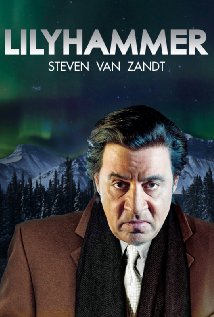
Review: Lilyhammer

What happens when a Mafia boss snitches on his own? I think most of us have a good idea, cement galoshes, getting a set of clubs, or swimming with fish come to mind. If a snitch is lucky, Witness Protection is an option, if the snitch can elude the Mafia and those in league with organized crime long enough to relocate. But, what if relocation is not to another city in the United State, but to another country, a country who still revels in Olympic fame.

In 1994, Lillehammer, Oppland, Norway hosted the Winter Olympics. You may not remember. I didn't. I had a vague recollection of the Lillehammer Olympics but if you had asked me to find Lillehammer on a map I would not be able to immediately tag the city.

Lillehammer is about 2 hours drive north of Oslo, the capital of Norway, in the county of Oppland. Lillehammer today has a population of less than 30,000 residents, though I am sure in the days of the 1994 Olympics a few more people were present. Climate averages a balmy 45F in the summer, about 30F in the winter. Dress accordingly.

How in the world did a TV series featuring a New York crime boss snitch end up setting in Lillehammer?

Frank Tagliano (Steve van Zandt) is the heir-apparent to a New York crime family. When the godfather dies, the syndicate's accountant was able to insinuate himself into the power structure and usurp the usual chain-of-command. Upset by the turn of events, Tagliano decides to snitch on members of an Italian crime family. Tagliano is convinced after an attempt on his life to seek witness protection. Rather than stay in the United States, Tagliano decides to satisfy a dream of his and relocate to Lillehammer, Norway, home of the 1994 Winter Olympics. Tagliano developed a deep affection for Lillehammer watching the Winter Olympics. Soon, he is on the frozen Norwegian landscape living with the unlikely name of Giovanni Henrikson, a man of Italian/Norwegian ancestry.

"Lilyhammer" is not a comedy, er, perhaps it is, in the sense of a dark comedy. What would one expect when one of the most corrupt people in New York is transplanted to one of the most honest countries in the world? An effing clash of cultures in the vernacular of a New York mafia boss is what happens.

Tagliano tries to bribe the Norwegian equivalent of the business bureau so he can get around the typical bureaucracy. When bribery doesn't work, he blackmails the official with pictures. Lillehammer is simply not prepared for someone who works to circumvent the bureaucracy of a clean and reverent society and therein lies the awkward humor.

Tagliano joins the neighborhood watch program. While he is taping up his bat to keep it from slipping from his hands, the watch leader lets him know the program is 100% non-violent. "What do you do when you get the bastards?" Tagliano inquires. "We talk to them," replies the watch leader. "Really? You think that would have worked against Osama?"

Out on a walk one morning, Tagliano runs across the head of sheep on the sidewalk in front of his house. Now, typically, the head's of animals are viewed as bad omens by the Mafia. Tagliano gets his feathers ruffled, believing the New York Italian mafia has already found him. However, a woman steps up and collects her dinner from the snow. "You're gonna eat that?" Tagliano asks, obviously disgusted. "It's my dinner," says the woman, who turns out to be the police chief, and his neighbor.

Lilyhammer is filmed on location in Lillehammer, with Norwegian acting talent. Norwegian culture is ever-present, from the theme of non-violence, to the health care system. When Tagliano gets his girlfriend pregnant he balks at having a male mid-wife assigned to him. And, Tagliano's new Lillehamring business partners have no idea how to "encourage" people. Turning mild people into non-passive aggressive-types necessary for Tagliano's business practices wears him out.

Lilyhammer is a mash-up of "The Sopranos," on which Steve van Zandt played "Silvio Dante," and "Northern Exposure," on which Steve played no characters ;)

The show is a great watch, produced by Netflix studios and Steve van Zandt. Streams for free on Netflix, the first show produced by Netflix. If Lilyhammer is any indication of future programming then they are onto something.

If Steve van Zandt's name rings a bell, he is also a member of Bruce Springsteen's E-Street Band. Lilyhammer is in hiatus as Steve is on tour with The Boss.

Sunday, July 29, 2012

Southwest to San Diego

San Diego is as close to urban paradise as I can imagine. Specifically, the Gaslamp District is a fantastic downtown experience. I'm not a fan of traveling outside of San Diego, and I've not actually traveled outside San Diego, thus I cannot really be a fan of something I've no experience with.

[caption id="attachment_1179" align="alignleft" width="158"] A small San Diego condo building near the Gaslamp[/caption]

San Diego has marvelous apartment buildings. Lots of glass, balconies, and any room above the 3rd floor would have a view to kill for. Maybe. I can envision some people might not be comfortable staring out their window into the bedroom or living room of the apartment in a building mere yards away. A cozy relationship with your neighbors could possible result in tossing a ball between buildings, that is how close some of these buildings seem to be.

Nonetheless, I would live in downtown San Diego should Fortune or the Kentucky Lottery smile upon me. Sea breezes are cool and inspire meditation and contemplation of the Universe. My recent stay did not allow me to do so but under other circumstances I sleep with my windows open. Hotels without balconies do not have windows to open.I appreciate the symphony of the streets, from the sirens of police and fire trucks to the gaseous discharges of the city buses. I took my first San Diego city bus this trip, by the way, and I will probably never take a taxi nor shuttle again. For $2.25 a traveler can meet the bus at San Diego airport and be downtown in about 20 minutes. No better deal anywhere.

Sun, breeze, mild temperatures, the type of weather for drinking coffee in the morning and Guinness in the evening. Wearing long sleeves in the evening isn't a bad idea. Nights are chilly. I passed a small girl, pulled along by her father, chanting "cold-cold-so cold, cold-cold-so cold." Thermal heaters grace the outside eating areas but away from these sitting in chilly air can be uncomfortable.

Living downtown is not cheap. I found a place I could rent for about $1,280/month. Not too bad. Most of the condos I found were about far and away more expensive. When in downtown areas which have been redeveloped I wander around looking into realty offices hoping to get a sense of property values. The area around San Diego's Gaslamp district is prime real estate. Not as prime as London, but nice places are a premium. I'm sure lease rates are dependent upon view, seaside versus downtown. Expect to pay one-quarter to over 3 million dollars for a downtown condo. I suspect the closer to the top also puts sale prices near the top-end, too. I'm not sure where "regular folk" live. Next time I'm around downtown I'll ask.

[caption id="attachment_1181" align="alignright" width="189"] East River Crossing, playing at the Field[/caption]

Grocery stores, like Ralph's and neighborhood bodegas are handy. 7-Elevens, Wendy's, Subway litter downtown. My suggestion, don't waste your time. OK, 7-Eleven is a valid stop for snacks, coffee, and emergency beer. I'd rather recommend a few other places. At 5th and Market is The Field a favorite hang-out of mine when in San Diego. On a recent Monday night, the band "East River Crossing" was playing. A huge group of girls packed the joint and sang along to all the traditional Irish tunes. Sang along because they knew the words - to the Irish folk tunes - all the words. Even the audience response lyrics. 30-some-odd girls, all dolled-up, singing Irish folk songs like they knew them by heart. And, they did know the words by heart, as they turned out to be Irish girls on Study Abroad and were soon heading home.

Another favorite of mine is Dublin Square, at 4th and Market. Again, great food and cold Guinness. One of my favorite memories of San Diego goes back to my first trip. I found DS by accident and wanted Guinness and Shepards Pie for dinner. What I discovered I'll never forget. A young woman had brought her harp. Not the little hand-held harp but the stand-up floor model. Then, she sang. Her voice silenced the room, her soft wailing Gaelic lilt mesmorized every patron. Passersby on the sidewalk outside slowed and stopped, her soft melodies putting them under her spell. That was 15 years ago. Both places can pour a Guinness the proper way, though both can get a little sloppy when the bar gets busy. Remember, ordering a Guinness can take 6-10 minutes just for the pour; 2/3rds for the initial pour, allow the beer to rest, then top off and allow to rest. Don't be a bastard and give the ladies a hard time. Guinness is not Bud Light.

[caption id="attachment_1184" align="alignright" width="210"] Drunken Noodles and Sake[/caption]

I have a new favorite restaurant. My buddy Dewayne sat for some new ink on Pacific Beach - a good place for new ink, just so you know. The tattoo artist recommended a new Asian restaurant, Gaijin Noodle and Sake House. Unless you are on a date, sit at the bar beside the grill. Watch the girls prepare your food. Everyone who works here is from Southeast Asia, or has roots in Southeast Asia, everyone except the head chef. He is from Italy. The girls will chat up a storm and will tell you all the details about their food. I ate drunken noodles and bacon-wrapped asparagus and three samples of sake. I really wanted the grilled pork kimchi yet they were out, so I was told, until I saw our chef lay some on the grill. Watching food grill to succulence on a grill is hard to resist and I didn't. I tried the grilled teriyaki beef tongue, which was marvelous; like chewy bits of steak. And, they have S'mores on the menu for dessert and really roast large marshmallows over an open flame. Definitely will be back for seconds, or fourths.

If you are headed to San Diego anytime soon, and you enjoy Irish food, Guinness, or are looking for some new Asian cuisine, I've given you some food for thought. The prices are good, food is good, quickly served, and hot. Expect to watch football (soccer), or rugby on the tellies, perhaps the Olympics.

Monday, July 16, 2012

Book Review: Ghost Train to the Eastern Star

Ghost Train to the Eastern Star, by Paul Theroux. Mariner Press. 2008. Paperback. $16

My next door neighbors left for a two-week trip at the beginning of the summer. Their 40-ish daughter wanted to revisit the place of her birth. One can only imagine the thoughts crossing through one's mind causing someone to want to return to the scene of the crime. Their grumblings indicated a slight reticence to indulge their daughter but nonetheless the couple, who are in their late 70s by the way, loaded up their trailer and headed off to South Dakota. Plans were to visit the university where my neighbor first taught. Then, they would all tour the hospital where the daughter was born.
"And, this is the room where the doctors were screaming at your mother to push. They discarded your placenta into a dish located right about here..."

I should not poke fun. I have parallel sentiments. My family is from Kansas and Nebraska, and I spent many a summer playing in the sand along the shoulder of the street my father's parents house was located. A tiny little town in nowhere Kansas, which has become a den of meth and drug addicts today. Main Street was a 20-minute walk along a sidewalk. Along Main Street, you could visit the grocer selling out-of-date soups and canned food. The drugstore sold comic books with the covers missing. As a child, I was irritated by missing comic book covers. Later, I would understand, Frank, the druggist had cut the covers off to get credit for the unsold comics, yet then turn around and sell the comics to me, or some other kid.

As we get older and reminisce about our "Good Ol' Days" the thought of visiting our roots crosses the minds of people. The exploits of our youth, friends and adventures, appeal to us.

In the 70s a married Paul Theroux embarked upon a journey across Asia by train. Alone, with few belongings, a bag with paper, pens, and some clothes, Theroux set out to discover. Simply that: discover. He left behind a wife and the comfortable existence of life in the U.S. and western Europe for the unknown rigors of life in Asia. Along the way he met hundreds of people, friendly, cautious, yet warm and compassionate to an American stranger traveling alone.

In 2006, Paul retraced his steps. To a large extent he was successful, able to traverse a near precise path to the path forged 30+ years earlier. Iran, Iraq, Afghanistan, and Pakistan were avoided; too dangerous for a sole American to travel through, or overtly unfriendly to Americans. I suspect had appropriate travel plans been made, Paul may have been allowed to travel in Iran. Rick Steves traveled Iran in 2007 with a government-provided companion and a set of rules to abide by. In fact, Rick's travel video of Iran is available, in full-length, via YouTube (video).

Reading Paul is like reading someone's diary. That Paul reveals so much about himself and his surroundings makes his prose touching, intimate, and powerful. Paul is not writing to communicate the skim coat of life, the veneer of lovely places. As we all know, life is not like that.

An autobiography of sorts, too; Paul shares the demise of his first marriage, making no excuses, and asking for no forgiveness. Traveling as a young man, he perhaps made some poor choices; and his wife herself made some equally poor choices. Anyone who chooses to retrace his or her own personal history may attempt to deflect the memories of the past. Why? Is not the journey itself part of coming to terms with history? Paul essentially asks and addresses his own complicated past while engaging us in the discovery of the past, present, and future of the people along his rail journey.

Theroux is a journalist, an investigative reporter, an essayist, yet he doesn't simply report, he allows us to see his thoughts and feelings, not merely the visuals of his environment, not the droll tidbits of conversation one might have with an interview. His journeys are not the ones you will find in Lonely Planet nor Fodors.

Theroux wants to see people and cultures as they are, not as they want tourist to see them. Theroux endeavors to strip away the lovely bits of society to understand the real issues and concerns of people. When traveling through Cambodia, a state he had to bypass on his first journey, Paul writes
"It gave me the creeps to read all this while I was staying in Phnom Penh. Some of the worst killing had occurred while I was taking my Railway Bazaar trip, and then writing it, complaining that it had been impossible for me to visit Cambodia. Little did I know what was happening here - but not many people on the outside knew much, or cared."

During his Railway Bazaar trip, Pol Pot and the Khmer Rouge were turning schools into prisons, executing fellow Cambodians with farm implements, or bashing children against trees. Water torture, not unlike that condoned by Dick Cheney was used to extract "confessions" from innocent people who were eventually murdered and buried in mass graves. Today, open air museums allow visitors to witness the staging areas, what are today known as "killing fields."

I've thought highly of Singaporean society until reading Paul's account. While Singaporean society is fanatically clean, ordered, and disciplined, Paul paints a picture of inordinate structure and intolerance and little appreciation for humor. People are not polite and lack any incentive to be polite. Strange when contrasted with Cambodians and Vietnamese, against who major atrocities were committed yet have remained spiritual and compassionate. I've entertained notions of visiting Singapore, an Asian Tiger and a society whose technological achievements are equal or superior to the United States, Canada, and parts of Europe. However, Paul makes a convincing argument to visit Cambodia or Vietnam first and learn from people who are some of the most humble people one will ever meet.

As an American abroad, Paul ran across people who felt compelled to share their unique insight into the US involvement in Iraq, and Afghanistan. People by and large sided against the US and especially George Bush. In a few cases, the US had a few allies, places which were draconian, such as Turkmenistan. The affinity of Turkmens with Bush does not bode well; the president of Turkmenistan was a megomaniac who renamed the months of the year after family members, renamed the days of the week after family, and commissioned giant golden statues of himself.

Theroux reunited with people he had met from his first journey and with educators he had been contemporaries with at teaching institutions. Through these conversations, we learn about the cultural changes over the 30 years. In many ways, few substantive changes had rippled through the societies. Extreme cases, such as the removal of Pol Pot had altered Cambodian society but the new government had its own repressive policies. On the other hand, Afghanistan could not be traversed and Pakistan Paul deemed as being unsafe. Daniel Pearl had recently been take hostage and Westerners were being targeted.

The more some things change, the more they remain the same.

In Sri Lanka, Paul was granted an audience with Sir Arthur C Clarke. Sir Clarke, a British expat living on the island, is credited with inventing GPS, or at least setting forth the idea of a network of satellites which would help define location. Clarke is also reknown for his story, The Sentinel, from which his later novel, "2001: A Space Odyssey," grew. A later book, "Rendezvous with Rama," maybe produced into a movie. A sad meeting, though, as Sir Clarke was in his twilight, capable of speaking, yet incapable of really having a coherent conversation. Sir Clarke would pass away not much longer after their meeting.

The lives of people outside North America are so different from what U.S. citizens experience as to almost be alien. In fact, I would argue, their experiences are not alien, ours are. We are the odd ones out, not they. Few US citizens have to subsist on $1 a day, or have to hang out lamps to attract bugs to eat, or find alternate sources of protein and carbohydrates. The vast majority of the world operates under such conditions. A bowl of rice, or a bowl of rice noodles, portioned with some form of meat, chicken, pork, or vegetables. We can avoid witnessing poverty. We don't have to push past poor people, poor children, poor elderly who sit on sidewalks, or run up to us asking for money. Not that places in North America do not exist but back alleys where one could have sex with a child may be merely one block from the main tourist street. This is the strength of Paul's writing; he says what he thinks and communicates what he sees, and pulls no punches. He is persona non grata in Singapore due to his criticism of the government.

Ghost Train to the Eastern Star is not a pretty book; not a "Walking Tour of Britain." Chances are, you will find something offensive, but offensive in a positive way, such as those Western men who travel to Asia to avail themselves to desperate situations and people.

Ghost Train to the Eastern Star was my first Paul Theroux book. I've another cued up to read, Dark Star Safari, an account of his travels across Africa, from Cairo to Capetown. I can't wait to read.

Pax

Thursday, June 7, 2012

Amateur Traveler Podcast Entertains & Educates

A perfect job would include reading and writing and traveling. And, eating the local cuisine. And, drinking some local beers. Sounds like the perfect job to me. Traveling the globe, writing, reading, eating and drinking… yeah, Anthony Bourdain has pretty much the world's best job.

I don't travel much. Teaching geography, one would think I travel a lot. I did as a child. My parents, especially my father, drove us all over the American Southwest. Arizona, New Mexico, and southwest Colorado have a special place in my heart. As an adult, I've made a couple of really bad choices with my revenue stream which I get to pay for into the next decade. I also had stomach surgery years ago which left me unable to vomit. To be a really adventurous traveler, one needs to have the ability to puke. Bacteria conform to a certain geography. Not all places have the same bacterial flora as Kentucky or Missouri or Arizona. People living in Eastern Europe, Russia, Sub-Saharan Africa, Argentina do not have identical intestinal flora.

When we travel to exotic places our bodies need time to adjust. The "adjustment" period goes by several names, like "traveler's tummy" or "montezuma's revenge." I do not like the fact I only have one egress for problem foods and substances so I pay attention to where I travel and what I eat.

From spectrum of human conditions arises an interesting question:
"What can a person who might be home-bound or otherwise unable to travel do to develop some sense, experience or knowledge of other places ?

With such cable stations like The Travel Channel and Public Broadcasting shows like "Rick Steves' Europe" anyone with access to cable television or the Internet can travel vicariously through others to far-off lands and never leave their kitchen table, desk, or bed. I recommend one should try to travel someplace, Canada, Mexico, the Caribbean, England or the United Kingdom of Great Britain or Ireland, or even Japan. All U.S. citizens should try to travel outside our country once in a person's life. I do recognize traveling may fall outside a person's ability or means, though.

One of my favorite podcasts to which I frequently listen is Chris Christensen's "Amateur Traveler." The Amateur Traveler podcast is a 30-60 minute interview-style podcast. The host, Chris Christensen, interviews a person who has recently returned from a trip somewhere. You can literally replace "somewhere" with a place name and Chris has probably interviewed someone who has traveled there. I believe the archive of his podcasts date to 2007 and perhaps earlier. I am guessing he has over 500 shows available through iTunes.

Over the last week or so, I've listened to travelers tales of Cyprus, Bulgaria, two places in China, Stonehenge, and Oklahoma. Yes, even places in the United States are fair game. Today, I downloaded a podcast for Brooklyn, NY. I also downloaded a podcast for Northern Iraq, too, and Bangladesh.

Chris is a great host. He has traveled extensively himself and often has knowledge of the precise place the interviewee has visited. His geographic knowledge is pretty vast allowing him to ask good questions, and good follow-up questions. He allows his guests to talk freely, as well. He does not talk over them or interrupt. He asks good leading questions which help the guest interpret their travel, as well. You can almost hear the guest's voice change as he or she realizes some new impression or detail about their trip.

Throughout their conversation, which is really what the podcast feels like, that you are simply eavesdropping on two or more friends talking about their travel experience. The conversation is light-hearted yet educational. Chris makes sure to hit the mark, covering climate, weather, the best time to travel, the worst time to travel. He also helps listeners plan their own expedition, in essence.
"If you had to give someone advice about traveling to Albania what would you want people to know?'

Some of his guests are not professional travelers. They sound as if they have not given much thought to helping someone travel. When posed with question like the one above novice travelers will stumble. Other guests are very seasoned travelers and watchful of traveling pitfalls and very willing to share their experience. Some of his guests have worked for language programs, or health programs, have experiences related to mission trips or aid organizations. Some of his guests simply travel for fun, using vacation time. Regardless of the guests background Chris is deftly able to entice an interesting conversation even from such mundane a place as Oklahoma.
"You know you are in Bulgaria when ___[blank___.

Every place has a "feel," and "atmosphere" which you notice almost after deplaning or going ashore. How do you know you are in a specific place versus being someplace else? What gives your new location away as being unique? The question above Chris poses to his guest. Without video or pictures, how do you communicate the essence of a place in audio only when your audience has no experience of such place?  Chris asks the same set of questions near the end of his podcast. The guest, who I think may be brief on these question ahead of time - yet many never seem to give the questions much thought, surprisingly - often let their minds wander for several seconds as he/she tries to recall definitive memories of their time.

After listening to a few episodes traveling seems easy and within reach of everyone and anyone. Whether you merely want to investigate St. Louis, Missouri, Portland, Oregon, or Prague, Czech Republic, the Amateur Traveler podcast will lure you into fulfilling your own travel dream.

Here is what I do. I like music and listened to music as I exercised but at some point I felt as if I really should be learning something during the 1-2 hours of exercise time, jogging or rowing or biking. I decided to load up my iPhone with Amateur Traveler podcasts and listen to stories of people who have used their time wisely, traveling to interesting places or traveling to mundane places and uncovering fascinating stuff, such as the best Vietnamese dining west of the Mississippi in Tulsa ( I think; could have been Oklahoma City). When I jog, I'm learning new geography, which is what I'm supposed to being doing - expanding my horizons and educating myself.

I also listen at work. I have the luxury of not sharing an office with anyone. When I get bored with NPR I'll tune in the Amateur Traveler and learn something.

Do your brain some good and plug in some Amateur Traveler while you drive your daily commute or exercise.

The Amateur Traveler. Chris Christensen, host. Podcasts available via iTunes Store. Free.

Thursday, October 16, 2008

Google Earth's Coolest Addition

Webcam Paris la Tour Eiffel - Europe, France, Paris 15

I was setting up Google Earth for my lecture/discussion on the Middle East last night and noticed a funny new icon I had not noticed before.

In Google Earth, I always click on icons I am unfamiliar with just to see what happens. Maybe not always a good idea. I trust Google explicitly, though ....

Anyway, I discovered this great new addition: Webcam.travel. People from around the world have posted geotagged webcams to Google Earth. Now, anyone from around the world can visit webcam.travel, or load up Google Earth with the Webcam.travel layer loaded and look at conditions - as they are within a few minutes - almost anywhere in the world. Man, this is awesome!

We looked at Rotterdam, the Netherlands, after taking our map quiz over Southwest Asia. Part of the webcam.travel website includes a Google Map showing the location of the webcam, giving you an idea of where you are within a city, town, village, etc. Plus, you can view the typical Google Earth satellite imagery or map layer to give you a bird's eye view of the area you are looking at. The Rotterdam perspective seemed to be directed to the ocean; the view was brilliant, almost like the city was on fire. I thought I was looking at the fires in southern California at first, before I noticed the webcam's title, and vicinity. The webcam captured the intense illumination in the area, bright, saturated yellows and golds of urban lights. The skies were low and overcast, giving the effect of smoke. Taken all together, the image appeared to be that of many lines of fire, when in actuality, we were looking at four-lane highways, industrial districts, and other urban features. Cool stuff!

Sunday, October 5, 2008

Country VS Realm VS Region

One of my pet peeves is the misidentification of a realm or region as a "country."

For example, what raised my ire was an Apple iTune podcast description for the show, "travel geography." The premise of the show invites people who have traveled abroad to discussion their journey. A description of the show is posted to help the listener decide what to listen to.

In one case, a two-part episode description invited listeners to learn about the travels of a few people who had traveled across the "country" of Asia.

The "country" of Asia? You've got to be kidding me. And associated with a podcast called, "travel geography," no less.

Maybe they meant "China" or "South Korea;" or maybe they meant to say the "realm of Asia," rather than "country."

A 'country' typically is thought of to be a political area on the landscape, where the area is governed by the people that inhabit the area, and others outside the area recognize the sovereignty of the area. Such as Germany, or Portugal, or Uruguay.

A 'realm' is a large area that encompasses many different countries, contains a great number of people, and is a mostly inhabitable territory. Such as Asia, Africa, or Latin America.

A 'region' can be defined by a number of subjective characteristics. Regions can also vary by scale. A region could exist at a very local scale, such as around a town or city. A region could exist at a national scale. US states that receive a good deal of sunlight and also receive a number of retirement migrants are part of the Sunbelt. States that are perceived to have strong religious faith fall into the Bible Belt. These are perceptual regions. They encompass a number of administrative units, i.e. states, and are a subset of the larger "realm."

By the way, one of the best iTunes podcasts is The Amateur Traveler. The guy that does this does a great job.